I thought that maybe the veterans out here might know this answer. I haven't been able to confirm this yet through my research.
What Honda plant produced the CA95?
From the owner's manual, it lists the Hamamatsu plant as producing the C92 and CB92, but I couldn't find a mention of the C95 or CA95. The Suzuka plant seemed to build most of the 50s, while Saitama produced the C72 and CB72.
Where did our beloved CA95s come from?
Where were the CA95s Manufactured?
Yeah, I read those pages but didn't see anything on the CA95 (or the general export C95). Just the 92s.92merc wrote:According to my Benly's Driver's manual:
Hamamatsu: C92, CB92
Saitama: C72, CB72, C200, CL72
Suzuka: C100, C102, C110, C114
But you're right, no CA listed. Weird. I would assume the Hamamatsu plant since that's where the other 92 engines are.
-
Jetblackchemist
- Posts: 463
- Joined: Thu Apr 28, 2011 10:59 am
The chart in the book is misleading...
Honda had a widely dispersed system of production, it involved every factory and was lacking the efficiency Mr. Honda wanted. It did have certain advantages however, since all factories were able to acquire experience in production.
Honda's engines were manufactured at the Saitama Factory, Bodies at Suzuka, and transmissions were made at Saitama Factory and Hamamatsu Factory. Final assembly took place at the Saitama plant.
The Saitama plant opened in 1953, Hamamatsu was the first plant that produced motorized bicycles, the plant moved to a larger facility in Hamamastu in 1954. In 1960 the Suzuka plant opened and was responsible for R&D. The 1959 was produced in the Saitama and Hamamatsu, later versions in all three as stated since the Suzuka plant was built to handle their aspirations for export. It is also important to note that the CA95 was only made from 59 to 63 the ones made after 63 received the C95 designation.
Hope I cleared things up abit.
Honda had a widely dispersed system of production, it involved every factory and was lacking the efficiency Mr. Honda wanted. It did have certain advantages however, since all factories were able to acquire experience in production.
Honda's engines were manufactured at the Saitama Factory, Bodies at Suzuka, and transmissions were made at Saitama Factory and Hamamatsu Factory. Final assembly took place at the Saitama plant.
The Saitama plant opened in 1953, Hamamatsu was the first plant that produced motorized bicycles, the plant moved to a larger facility in Hamamastu in 1954. In 1960 the Suzuka plant opened and was responsible for R&D. The 1959 was produced in the Saitama and Hamamatsu, later versions in all three as stated since the Suzuka plant was built to handle their aspirations for export. It is also important to note that the CA95 was only made from 59 to 63 the ones made after 63 received the C95 designation.
Hope I cleared things up abit.
Now that part is confusing. My '65 frame number and engine number both begin with CA95. I understand that the CA95 'early' edition was 1959 to early 1963, but I thought that the CA95 was the American export model name right up until the final bikes were unloaded in 1966, replaced by the CA160.Jetblackchemist wrote:It is also important to note that the CA95 was only made from 59 to 63 the ones made after 63 received the C95 designation.
-
Jetblackchemist
- Posts: 463
- Joined: Thu Apr 28, 2011 10:59 am
Ok, did a lot of research the Honda history site is scattered and confusing, so I fired up a Japanese browser and got the information. The CA was the designation for exports to the US that's what the "A" stands for American, the Asian markets got the C models. The reason for this was Honda wanted to release the Benly at the same time as the Super Cub, but they had a design flaw where roughly 150 engines in the first export locked up. Honda didn't fix them in the US they exported them all back to Japan to redesign, this really impressed the dealers. Honda decided that if they were going to succeed in the US market they needed stricter controls on the builds meant for America and thus the "A" addition was born. It makes me wonder if those first few that hit our shores had the C95 designation? It seems very likely. Also of note Honda released different models to different markets at different times, The CA77 305 was here first, a few years later around 63' they released it to Asia calling it the C77.
Last edited by Jetblackchemist on Fri Feb 10, 2012 3:07 am, edited 2 times in total.
Reason: replace bad info
Reason: replace bad info
Another key difference with the 'CA' models was the lack of turn signals. The US Dept of Transportation regulations stipulated a minimum distance between the turn signals, and the early Honda models (Dream, Benly, Super Cub) mounted the lenses directly on the rear fender and front handlebars. Honda simply omitted the turn signals from the CA models in order to sell them in the US and other countries with similar regulations.Jetblackchemist wrote:Ok, did a lot of research the Honda history site is scattered and confusing, so I fired up a Japanese browser and got the information. The CA was the designation for exports to the US that's what the "A" stands for American, the Asian markets got the C models. The reason for this was Honda wanted to release the Benly at the same time as the Super Cub, but they had a design flaw where roughly 150 engines in the first export locked up. Honda didn't fix them in the US they exported them all back to Japan to redesign, this really impressed the dealers. Honda decided that if they were going to succeed in the US market they needed stricter controls on the builds meant for America and thus the "A" addition was born. It makes me wonder if those first few that hit our shores had the C95 designation? It seems very likely. Also of note Honda released different models to different markets at different times, The CA77 305 was here first, a few years later around 63' they released it to Asia calling it the C77.
For my restoration, I've purchased a C95 wiring harness, the correct aluminum C95 turn signal switch, a 6 volt flasher, and the correct front/rear turn signal lights. I'll feel a bit safer with signals, and wanted the correct 'C95' appearance, so that meant no aftermarket turn signal kits. I've done the same with my CA102 Super Cub, adding the C100's flashers.
-
weestrom05
- Posts: 100
- Joined: Thu Apr 21, 2011 8:14 am
turn signals
I see the front signals on ebay all the time and the lenses for the rears also. Do the rear lenses just screw to the fender stay or is there a base for them? That is a mod that I would like to add to my ca95. Thanks
Curt
Curt
For the late edition CA95 ('63-'66), the space for the rear signal lens was simply filled with a 'Honda' badge. Remove this Honda badge and add the lens. Below is a picture of my fender braces, one cleaned up and holding the rear lens.weestrom05 wrote:I see the front signals on ebay all the time and the lenses for the rears also. Do the rear lenses just screw to the fender stay or is there a base for them? That is a mod that I would like to add to my ca95. Thanks
Curt
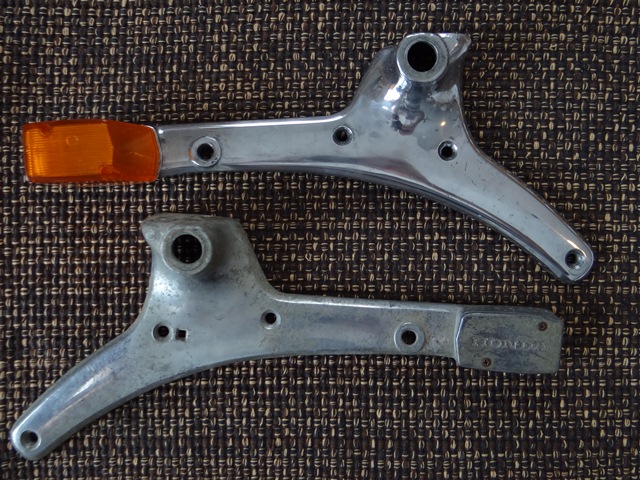
The rear lenses don't come with lamps or sockets, so you'll need to find 6-volt lamps to mount inside.
The aftermarket front signals are plastic replicas of the original handlebar-mounted design, but they'll look fine.
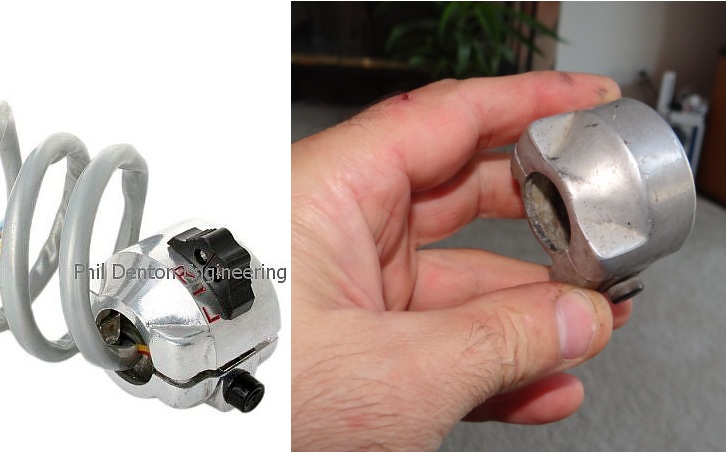
Since the original right-hand switches cost a fortune on eBay, I ordered my replica aluminum switch from Phil Denton Engineering in England. It's an exact copy. Below is the new switch next to my original one.
You'll need a 6-volt flasher to mount. The parts manual shows the flasher mounted in the frame cavity, not far from the rectifier, if you're interested in authenticity. Otherwise, mount it anywhere out of sight.
This wiring diagram has the C92/C95 wiring that shows the 'winkers'.
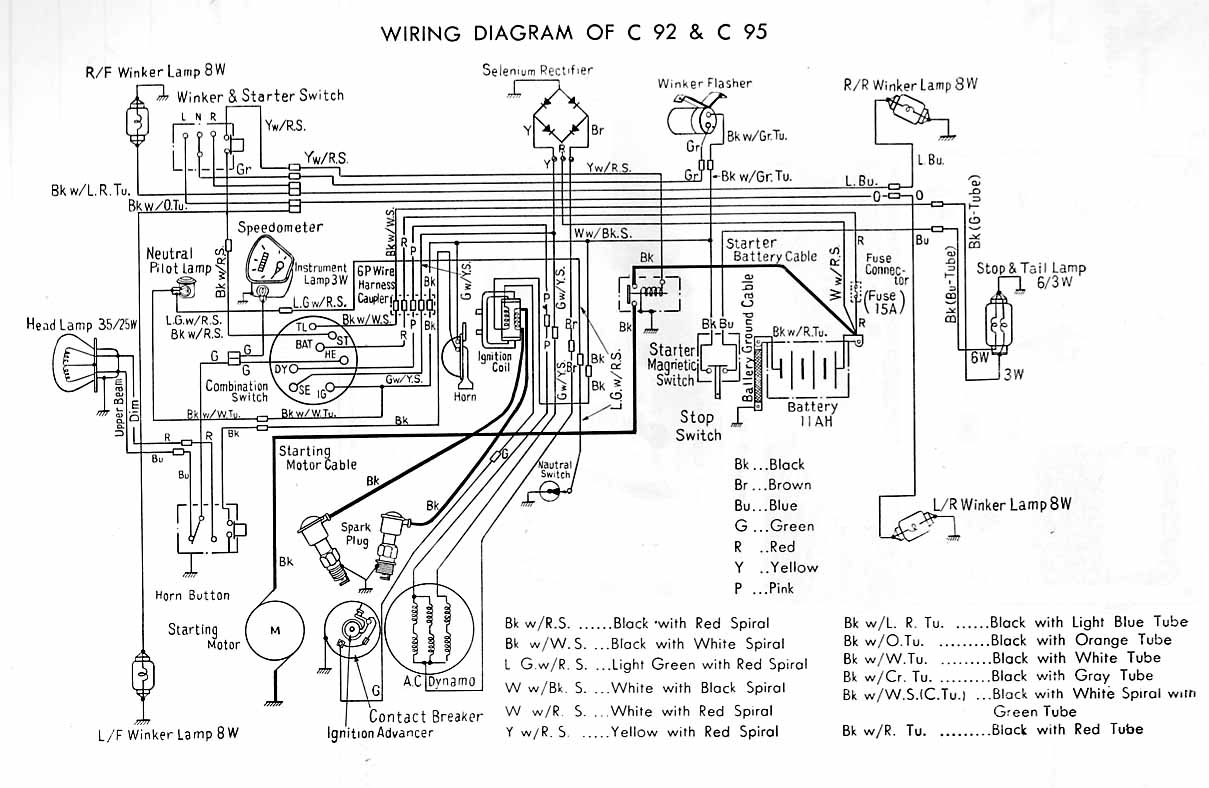
Since the C95 wiring harness was only $19.99 plus $12 for shipping, and because a family of mice shredded some original wiring, I opted to replace the harness instead of just adding the turn signal wiring.
-
weestrom05
- Posts: 100
- Joined: Thu Apr 21, 2011 8:14 am
turn signals
Thanks for the info on the turn signals. One quick question though, Mine is a 62 or early type. Is there any difference in the fender stays?
thanks Curt
thanks Curt
-
Jetblackchemist
- Posts: 463
- Joined: Thu Apr 28, 2011 10:59 am
The fender struts should be the same for all years...although, I am not sure about the 59' model braces. Mines a 63 and there's plenty of room under the badge for mounting lamps. I liked the badge and wanted to keep it, so I mounted some bullet style blinkers in the hole right before the badge. I know Spokes has mounted blinkers using the badge spot, so he would be good to ask.
If I were using the badge spot and the same lenses that lake has, i'd buy some really cheap blinkers and dissect the internals to mount to the strut, the screw hole for most blinkers also hold the lens on, since you wouldn't need the housing or lens, the bulb mount could be bent using the hole meant for the other lens or drill a new one to fit the mounting hole under the badge.
I bought some bars listed as ca95 bars that had all the controls and the blinker switch, they were listed wrong and not off of a Benly. I did find out what bars they were but I cant remember right now. I had to grind the bar in the middle so the bar clamp would fit, they are not as wide as the originals, and the wiring colors all wrong, but in the end they couldn't have been better. The pain in the ass part was a good learning experience. They only cost me around 15.00
I'd check around for other early Honda bars some might have the switch already on them, like mine did if you don't have the switch. I'd have used the switches on the old bars, but rust won the war on those years ago.
If I were using the badge spot and the same lenses that lake has, i'd buy some really cheap blinkers and dissect the internals to mount to the strut, the screw hole for most blinkers also hold the lens on, since you wouldn't need the housing or lens, the bulb mount could be bent using the hole meant for the other lens or drill a new one to fit the mounting hole under the badge.
I bought some bars listed as ca95 bars that had all the controls and the blinker switch, they were listed wrong and not off of a Benly. I did find out what bars they were but I cant remember right now. I had to grind the bar in the middle so the bar clamp would fit, they are not as wide as the originals, and the wiring colors all wrong, but in the end they couldn't have been better. The pain in the ass part was a good learning experience. They only cost me around 15.00
I'd check around for other early Honda bars some might have the switch already on them, like mine did if you don't have the switch. I'd have used the switches on the old bars, but rust won the war on those years ago.
There were indeed differences between the early and late rear fender braces. The 'early' CA95 ran from 1959 up to frame number CA95-3106640 in 1963. Others have covered the differences between the early and late CA95s in other threads, so I won't try to replicate that, but visually, the major differences are the rear fender brace and the fuel tank panel.
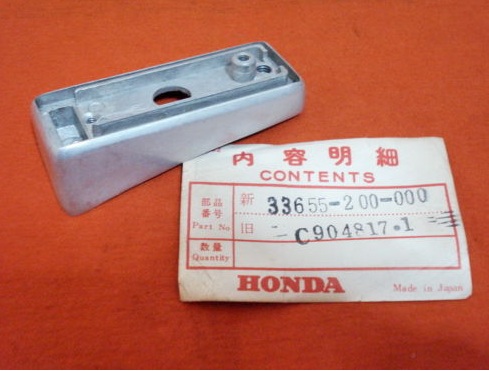
The 'late' CA95 fender brace was lengthened to incorporate the rectangular rear signal base that was a separate part with the 'early' C95.
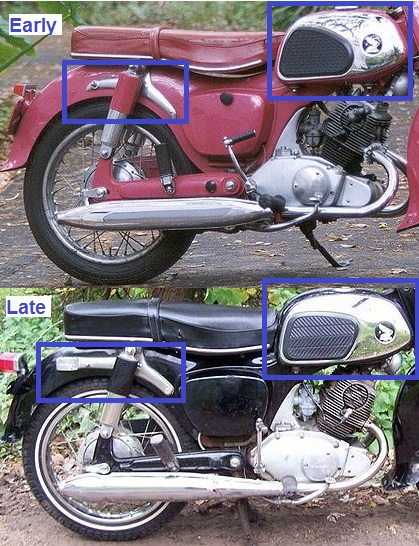
Unfortunately, the early CA95s didn't include that rectangular base that the general export C95 did. Those of us with 'late' CA95s need only remove the rectangular Honda plate to mount a lens. The mounting plates for the early C95 are available but are pricey. You'd need both a left and right side plate.
The 'late' CA95 fender brace was lengthened to incorporate the rectangular rear signal base that was a separate part with the 'early' C95.
Unfortunately, the early CA95s didn't include that rectangular base that the general export C95 did. Those of us with 'late' CA95s need only remove the rectangular Honda plate to mount a lens. The mounting plates for the early C95 are available but are pricey. You'd need both a left and right side plate.
Last edited by ByTheLake on Wed Feb 15, 2012 2:50 am, edited 2 times in total.